How TEOS united 3,500 employees at Capgemini's HQ, slashing unused rooms from 40% to 8%
Global technology leader with nearly 60 years of heritage, Capgemini brings together 320,000+ professionals across 50+ countries to deliver business and technology transformation, making workplace efficiency and collaboration a strategic priority at scale. Capgemini's partnership with TEOS dates back to 2016, when the company first deployed the TEOS suite for room management and digital signage across its offices in Milan, Nantes, Lille, and its campus in Chantilly.
Building on that success, Capgemini turned to TEOS again for its next landmark project: a hyper-modern, eco-conscious new headquarters in Paris. Unveiled in July 2019 in Issy-les-Moulineaux, Le 147 is regularly welcoming visitors from Capgemini's offices across more than 50 countries.
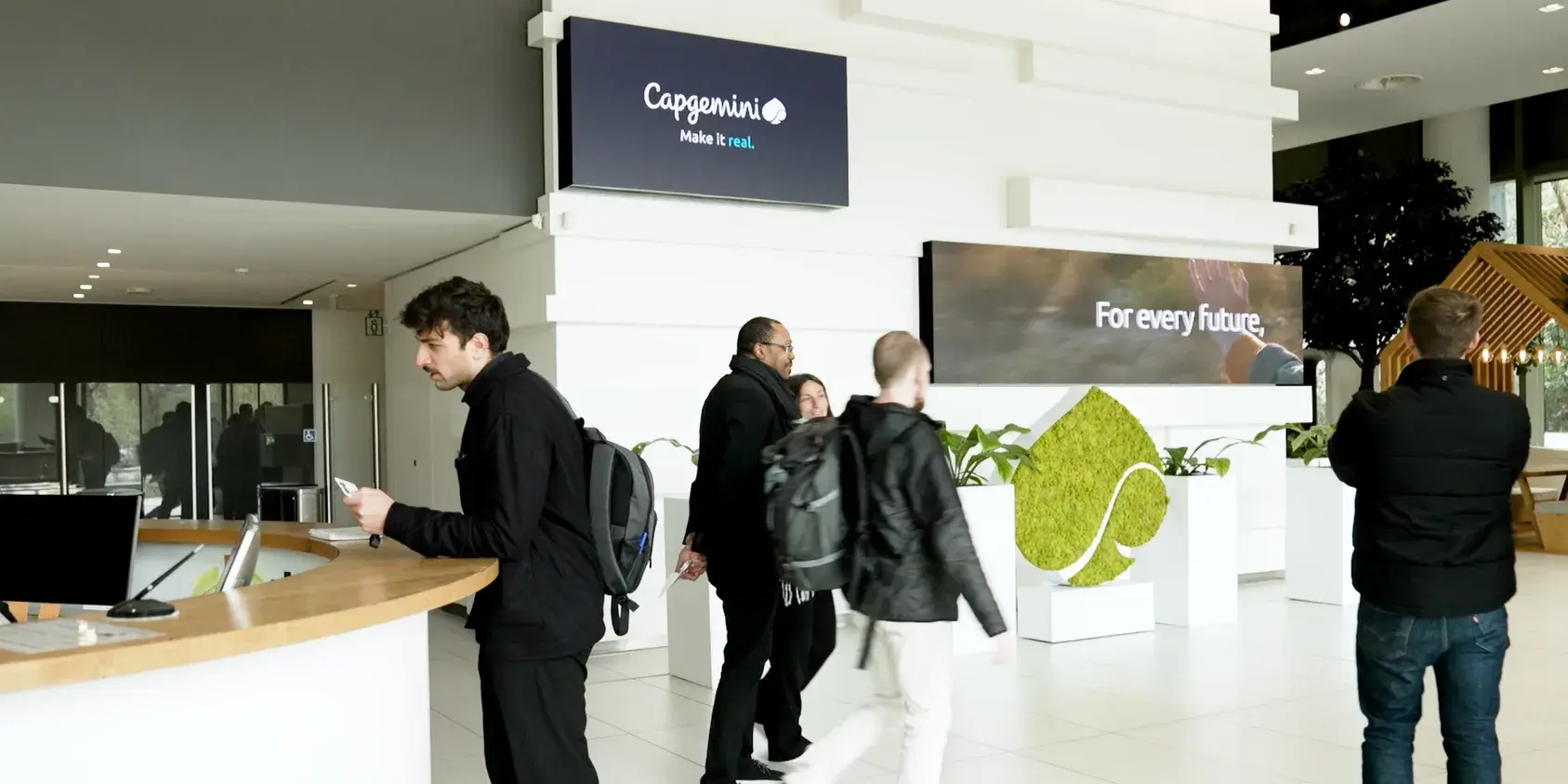
A landmark in sustainable workplace design, Le 147 holds Triple HQE certification and is powered in part by geothermal energy.
To match this vision, Capgemini needed a workspace management and digital signage solution that would maximize energy efficiency, streamline time management, and help both employees and visitors navigate the building, find meeting rooms, and stay informed and connected.
Merging eight Paris offices into one was no small undertaking.
Overnight, Le 147 became home to 3,500 daily users, while regularly welcoming visitors from over 450 locations across Capgemini's global network of 320,000 employees.
Managing the flow of people, information, and resources with one building now at its heart, demanded a smarter approach to workspace management.
Everything had to run smoothly. Before Capgemini started using TEOS, the client was facing a multitude of challenges with the workspace communication on a daily basis:
The TEOS team offered a solution and personalized it based on Capgemini's needs: a modular workplace platform with a single cloud-based control panel.
Capgemini could turn on only the features each location actually needed: digital signage, room booking, desk booking, wayfinding, and wireless screen sharing through TEOS Connect, saving money and having less impact on the environment.
How TEOS made the difference:
All devices, spaces, and content managed from a single control panel.
Corporate content pushed to any screen across all 30 locations in minutes, replacing updates that were previously months out of date.
Tablet booking stations at the Chantilly training center give employees instant visibility of meeting room availability across the site.
Rooms are flagged as occupied only when actually in use, not just when booked.
Existing screens were reused with a simple dongle, saving tens of thousands of euros and extending screen lifespan from 4 to over 7 years.
| Metric | Before | After |
|---|---|---|
| Rooms booked but empty | 40% | 8% |
| Time to update screen content | Days | Minutes |
| Meeting start delays due to tech issues | 10 min avg | Zero setup |
| Screen lifespan | 4 years (expected) | 7+ years (actual) |
When employees were confused about the meeting booking system, Capgemini pushed instructions to on-site screens straight away. What used to take days happened in minutes.
The next chapter of Capgemini's TEOS journey shifts from broadcasting information to collecting it.
With sensors and connected devices feeding real-time workplace data, from room occupancy to temperature, the platform is becoming the brain of the building.
TEOS continues to adapt alongside Capgemini's evolving needs, ensuring that what started as a signage solution grows into a fully intelligent workplace ecosystem.
Book a walkthrough and see the same modular platform that helped Capgemini optimize workspace efficiency and global communication.